
The purpose of this blog was to showcase other types of physics other than the LHC. But I can't resist, this is a really nice animated video showing the stages of getting stationary protons up to 7TeV
http://cdsweb.cern.ch/record/1125472
(via @CERN)
Friday, 20 November 2009

Thursday, 29 October 2009
Speed limit for computer processors - serial vs parallel
This news item from Nature about this PRL talks about how computer processors are going to hit a speed limit due to the speed at which a system can make transitions between quantum states.
I'm not an expert in quantum information so all I can say is that it looks interesting. There are implications for myself because most of my work is pretty intensive computer simulation. Some of what I do simply needs fast processors, there are sections of my Monte Carlo simulations that cannot be parallelised (fancy cluster algorithms being one). So for these, in principle, it limits what could ever be done.
However, mostly my limit is on what statistics I can collect and that can be solved by using more and more processors. The move from single core being standard, to eight these days, has been a revolution in terms of what I can now get done in a reasonable time scale.
In fact one very interesting development is using standard computer graphics cards to perform molecular dynamics (MD) simulations. I've only read the abstract of this paper I'm afraid but they've apparently done this. Graphics cards designed for games have many little processors on them (GPUs) and they can all work on the problem more efficiently than one super powered CPU trying to do it on its own.
So next time you say that computer games are a waste of time think of this...
There are two independent bounds on this minimum time — one based on the average energy of the quantum system, the other based on the uncertainty in the system's energy. In their calculations, Levitin and Toffoli unify the bounds and show there is an absolute limit to the number of operations that can be achieved per second by a computer system of a given energy.
I'm not an expert in quantum information so all I can say is that it looks interesting. There are implications for myself because most of my work is pretty intensive computer simulation. Some of what I do simply needs fast processors, there are sections of my Monte Carlo simulations that cannot be parallelised (fancy cluster algorithms being one). So for these, in principle, it limits what could ever be done.
However, mostly my limit is on what statistics I can collect and that can be solved by using more and more processors. The move from single core being standard, to eight these days, has been a revolution in terms of what I can now get done in a reasonable time scale.
In fact one very interesting development is using standard computer graphics cards to perform molecular dynamics (MD) simulations. I've only read the abstract of this paper I'm afraid but they've apparently done this. Graphics cards designed for games have many little processors on them (GPUs) and they can all work on the problem more efficiently than one super powered CPU trying to do it on its own.
So next time you say that computer games are a waste of time think of this...
Monday, 19 October 2009
There's more to the LHC than bloody black holes
The LHC is cold again. This is very exciting, and also it can't come soon enough. In the absence of any actual science going on an endless stream of bollocks seems to have been coming out about the collider. The latest being this drivel about things coming from the future to... oh God I can't be bothered. It rather upsets me that the only things people really know about the LHC are that it might make a black hole and maybe something is coming through time to sabotage it. So I thought I'd talk about why this machine is ridiculously fantastic and complicated (the more likely cause of breakage).
One of the features of synchrotrons that I've always thought is amazing is the way they cool the beams. By cool I'm not talking about temperature around the beam pipe (although that's bloody cold too so that the magnets work). I'll quickly describe what it is and how people solve it, although I'm still not 100% sure how they've solved it at the LHC.
Our general collider accelerates particles around a ring using strong electric fields. The particles are bent into a circle by bending magnets and they are kept in a beam by the focussing quadropole magnets. The effect of these magnets is that if a particle is heading sideways out of the beam then they push it back in in the opposite direction. In this way the particles kind of snake around the course never straying too far out of line. The task of cooling the beam is to reduce this snaking as much as possible so that we have a really dense, straight running beam.
Wednesday, 9 September 2009
Quorum decisions in bacteria
Stumbled across a few nice things related to quorum decision making recently. Remember how sticklebacks make their decisions? Well bacteria do it too, below is a great TED talk by Bonnie Bassler on how they communicate and how they decide to act as an enormous group.
Also came across this article on humans making group decisions in a Kasparov vs The World chess game. It gets the saliva flowing on how you can engineer good decisions.
Addition: Incidentally, I also think this talk is a great example of how to give a science talk. It's a little rushed (probably nerves) but the enthusiasm is fantastic and the use of visual aids is perfect. I'm giving a workshop on presentations so I've been thinking about this stuff a lot recently.
Saturday, 1 August 2009
Biological Membranes
It's been ages since my last post. This is because I've been busy doing lots of interesting physics, met a bunch of interesting physicists, maybe I'll write something about it. For now, something I've been meaning to write about for a while, and for once it's something that's timely.
The journal Soft Matter has an issue out with a membrane biophysics theme. You can read the editorial for yourself if you have access, otherwise make do with my ropey understanding of it. Soft Matter is a relatively new journal that I think is looking really good. Their website needs work but I'll leave that for my science 2.0 rant which is bubbling up.
So why am I interested in membranes (I'm not working on them, I'm just interested)? Well once again I'm interested in them as large system of small parts that make something amazing when they get together - ie statistical physics. So, here's my compressed guide to membranes: please remember I'm not a biologist, I'm very new to this, only barely understand it and I tend to over simplify things.
Wednesday, 10 June 2009
Hummingbirds are the fastest animals on Earth
Relative to their body size. Which completely changes everything. According to the Guardian
Which is nice, and the high speed photo is beautiful. But it's not really the same is it? In fact the space shuttle statistic sort of makes it seem silly. All the other important numbers, apart from velocity, don't scale with the animal size. The friction, reaction time, not least the speed of sound. It doesn't help me imagine what it feels like to be a hummingbird.
It's somewhat similar to all those statistics you see about insects. Fleas jumping hundreds of times their height and ants carrying many times their body weight. If you had a giant ant I doubt this strength thing continue, the strength of skeletons and legs just don't scale with height.
The dive tops out at 60mph which is pretty impressive, I'd love to know it in perspective with the reaction times of the birds. How does 60mph feel to them? Apparently at the bottom of the dive
That's definitely cool. So long as by g they don't mean in units of bird length again. Anyway, don't want to be too grouchy, the photo is excellent - enjoy.
 Photo by Christopher J. Clark and Teresa Feo/UC Berkeley
They can cover more body lengths per second than any other vertebrate and for their size can even outpace fighter jets and the space shuttle
Which is nice, and the high speed photo is beautiful. But it's not really the same is it? In fact the space shuttle statistic sort of makes it seem silly. All the other important numbers, apart from velocity, don't scale with the animal size. The friction, reaction time, not least the speed of sound. It doesn't help me imagine what it feels like to be a hummingbird.
It's somewhat similar to all those statistics you see about insects. Fleas jumping hundreds of times their height and ants carrying many times their body weight. If you had a giant ant I doubt this strength thing continue, the strength of skeletons and legs just don't scale with height.
The dive tops out at 60mph which is pretty impressive, I'd love to know it in perspective with the reaction times of the birds. How does 60mph feel to them? Apparently at the bottom of the dive
the hummingbirds experienced an acceleration force nearly nine times that of gravity, the highest recorded for any vertebrate undergoing a voluntary aerial manoeuvre, with the exception of jet fighter pilots. At 7g, most pilots experience blackouts.
That's definitely cool. So long as by g they don't mean in units of bird length again. Anyway, don't want to be too grouchy, the photo is excellent - enjoy.
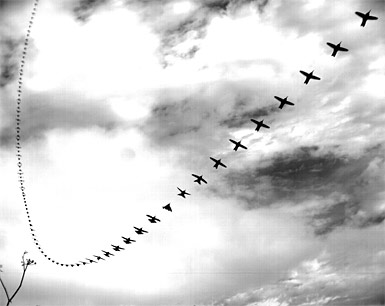 Photo by Christopher J. Clark and Teresa Feo/UC Berkeley
Saturday, 6 June 2009
Daisy world

A bit lazy linkage here. I went to a talk a while ago by Graeme Ackland from Edinburgh about Daisy World. It's not new, I think it's been around since the 80s, but it is quite cool. It's a really simple model of a planet where the climate conditions (here just the temperature) and the living organisms on the planet feed back to one another.
On Daisy World there are only daisies, there are a million extensions where they have forests and animals and all sorts. I think the simplest model gives the nicest story. This page gives a nice explanation and it has a java applet that you can play with - this is the best bit.
http://www.ph.ed.ac.uk/nania/nania-projects-Daisy.html
My extremely brief explanation is that there are white daisies and black daisies. White daisies cool down their environment, black daisies heat it up. If they get too hot or cold they die. Then there's a bunch of other parameters: how fast does temperature defuse, rate of daisy mutation, rates for birth and death etc. It's about as simple as it can be, and crucially is simple enough for mathematicians to come up with solutions.
The nice thing is that for reasonable parameters the system pretty much always self regulates. When things are slow to react, mutation rates are low, you get these big mass extinctions followed by regrowth. Really the best way to get a feel for it is to play with the simulations, it's very fun.
Subscribe to:
Posts (Atom)