
A while back the BBC put on an documentary about networks called "Six Degrees". Normally when you see a documentary about a field that you're vaguely related to you feel a bit sick because they did it all wrong.
Well I have worked in networks a bit and I thought Six Degrees was excellent. It got a great balance of the historical study of networks and then it ran its own version of the Milgram experiment which was mostly used as a plot device to keep driving the story forwards. The people involved (Watts, Strogatz, Barabasi) were all very entertaining and successfully transmitted the excitement of scientific discovery.
Suffice to say it was great. I had planned to link to it and then discuss it a little bit. Annoyingly the BBC have switched off the iPlayer version of the programme and they now appear to have shutdown the version at top documentaries.
I know the beeb don't want to give away content for free but it strikes me that a resource this useful (I'd even recommend it to scientists new to the field) should be kept live. Instead it's buried away where it's now useless. Scientists are always told about public engagement, well unblock this film - engage!
I'm going to write to them an encourage them to let it free, then perhaps instead of a rant about the BBC we can talk about some science.
UPDATE:
As you can see from the comments, the BBC didn't make the film so they can't keep it online. I can't work out how to get a DVD yet but when I find out I'll put up a link and then can get on talking about networks. In the mean time, this book, "Small World" by Mark Buchanan is well worth a read.
Showing posts with label media. Show all posts
Showing posts with label media. Show all posts
Thursday, 17 March 2011

Wednesday, 10 June 2009
Hummingbirds are the fastest animals on Earth
Relative to their body size. Which completely changes everything. According to the Guardian
Which is nice, and the high speed photo is beautiful. But it's not really the same is it? In fact the space shuttle statistic sort of makes it seem silly. All the other important numbers, apart from velocity, don't scale with the animal size. The friction, reaction time, not least the speed of sound. It doesn't help me imagine what it feels like to be a hummingbird.
It's somewhat similar to all those statistics you see about insects. Fleas jumping hundreds of times their height and ants carrying many times their body weight. If you had a giant ant I doubt this strength thing continue, the strength of skeletons and legs just don't scale with height.
The dive tops out at 60mph which is pretty impressive, I'd love to know it in perspective with the reaction times of the birds. How does 60mph feel to them? Apparently at the bottom of the dive
That's definitely cool. So long as by g they don't mean in units of bird length again. Anyway, don't want to be too grouchy, the photo is excellent - enjoy.
 Photo by Christopher J. Clark and Teresa Feo/UC Berkeley
They can cover more body lengths per second than any other vertebrate and for their size can even outpace fighter jets and the space shuttle
Which is nice, and the high speed photo is beautiful. But it's not really the same is it? In fact the space shuttle statistic sort of makes it seem silly. All the other important numbers, apart from velocity, don't scale with the animal size. The friction, reaction time, not least the speed of sound. It doesn't help me imagine what it feels like to be a hummingbird.
It's somewhat similar to all those statistics you see about insects. Fleas jumping hundreds of times their height and ants carrying many times their body weight. If you had a giant ant I doubt this strength thing continue, the strength of skeletons and legs just don't scale with height.
The dive tops out at 60mph which is pretty impressive, I'd love to know it in perspective with the reaction times of the birds. How does 60mph feel to them? Apparently at the bottom of the dive
the hummingbirds experienced an acceleration force nearly nine times that of gravity, the highest recorded for any vertebrate undergoing a voluntary aerial manoeuvre, with the exception of jet fighter pilots. At 7g, most pilots experience blackouts.
That's definitely cool. So long as by g they don't mean in units of bird length again. Anyway, don't want to be too grouchy, the photo is excellent - enjoy.
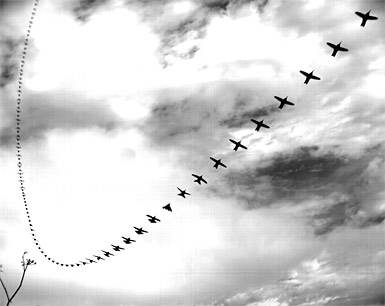 Photo by Christopher J. Clark and Teresa Feo/UC Berkeley
Monday, 2 March 2009
What should we know?
I decided a while ago that I didn't want this blog to be a bad science blog. There are plenty of those, I really like them but as the market's a little swamped I thought I'd just talk about stat-mech and hope that someone thinks it's interesting as well. Last weekend, however, I went to a talk by Ben Goldacre in Bath and so these things were brought to mind.
The thrust of the talk was that we, the public, are being misled and lied to by the media when it comes to science. He has compelling examples whereby the media would print unpublished stories from a discredited scientist but ignore several published articles that say the opposite. These examples are clear cut, the media are willing to lie for a good story. Even a well educated member of the public has no chance if information is being withheld.
What if it's less clean cut? Could the blame be shared in some cases? Take this story, the Durham fish oil trial (also mentioned in the talk, I don't have anything new). Uncritically reported by the media this "trial" had no control group, no predefined measure of success and more than a whiff that they knew what the outcome would be before it started. I need go no further describing it. The reasons why this "trial" was of zero scientific value are laid bare for anyone to see. The problem when one accepts what the article is saying (trial will prove fish oil works) without asking the huge question "where the hell's the control group?".
Anyone can ask this question. I expect people to ask this question. The concept of a control group is not difficult and everyone should understand it. In fact a full double blind trial is also easy to understand even if you didn't expect it to be necessary. There are certain things that I believe we should all just know about. Some good starting ones would be
Anyway, back to physics next time. There's lots I want people to know about physics but that's another fight for another time.
The thrust of the talk was that we, the public, are being misled and lied to by the media when it comes to science. He has compelling examples whereby the media would print unpublished stories from a discredited scientist but ignore several published articles that say the opposite. These examples are clear cut, the media are willing to lie for a good story. Even a well educated member of the public has no chance if information is being withheld.
What if it's less clean cut? Could the blame be shared in some cases? Take this story, the Durham fish oil trial (also mentioned in the talk, I don't have anything new). Uncritically reported by the media this "trial" had no control group, no predefined measure of success and more than a whiff that they knew what the outcome would be before it started. I need go no further describing it. The reasons why this "trial" was of zero scientific value are laid bare for anyone to see. The problem when one accepts what the article is saying (trial will prove fish oil works) without asking the huge question "where the hell's the control group?".
Anyone can ask this question. I expect people to ask this question. The concept of a control group is not difficult and everyone should understand it. In fact a full double blind trial is also easy to understand even if you didn't expect it to be necessary. There are certain things that I believe we should all just know about. Some good starting ones would be
- Double blind trials. For me I wouldn't have guessed they need to be double blinded, it's great that scientists don't exclude themselves from ruining their own experiments.
- Statistical significance. Small scale experiments can be good, but you need to be able to say when things could have been chance.
- Pattern recognition. Related to significance. People are pattern recognition machines, we see things where they are not.
Anyway, back to physics next time. There's lots I want people to know about physics but that's another fight for another time.
Saturday, 19 July 2008
Plausible theories from experts
This posting, from the rather excellent Mind Hacks, got me all worked up again (this is quite easy to do). It just struck me how easy it is to say something plausible, for example "increasing violence is caused by computer games", and then make no attempt to check whether it's true.
In this case the plausible statement is on the use of facebook, the internet, other such things. It even managed to be press released by the Royal College of Psychiatrists. This starts off
It seems that a horrible statistical fluctuation in the all-too-large distribution of teenage suicides is not a satisfying reason for the media or the public. And this leaves the door wide open for "experts" to fill the gap.
It's just too easy to say you think something is true and then press release to an unquestioning media. A classic example is the evolutionary psychology stuff (badscience has lots on this). These are the claims that we will split in to two distinct races or that we will evolve big willies. The papers just say that "Experts say..." washing themselves of responsibility. But who are these experts? Many of the proposals are plausible but that's not enough.
I could spend all day coming up with things that could be true. Unless it is testable then what use is it? Physicists come up with plausible theories all the time, but no one will get the nobel prize until it can be tested. The famous Feynman quote goes
To anyone claiming to know the cause of the Bridgend suicides I beg you to think carefully; teenage suicide is a serious problem and they deserve much much better.
Edit: Here's the BBC coverage
In this case the plausible statement is on the use of facebook, the internet, other such things. It even managed to be press released by the Royal College of Psychiatrists. This starts off
A generation of Internet users who have never known a world where you can't surf on-line may be growing up with a different and potentially dangerous view of the world and their own identity, according to a warning delivered to the Annual Meeting of the Royal College of Psychiatrists.Could be true. I wouldn't like to say. Things start to smell a little funny when they say
This is the age group involved with the Bridgend suicides and what many of these young people had in common was their use of Internet to communicate.OK stop there. Now I'm suspicious, don't all young people use the internet? By the way, the Bridgend suicides are also being blamed on mobile phone masts and, for all I know, computer games. In fact it feels like there is a rather sinister trend for untested/untestable claims to be applied to these tragic events, and why? Because it will get press attention. Without a doubt.
It seems that a horrible statistical fluctuation in the all-too-large distribution of teenage suicides is not a satisfying reason for the media or the public. And this leaves the door wide open for "experts" to fill the gap.
It's just too easy to say you think something is true and then press release to an unquestioning media. A classic example is the evolutionary psychology stuff (badscience has lots on this). These are the claims that we will split in to two distinct races or that we will evolve big willies. The papers just say that "Experts say..." washing themselves of responsibility. But who are these experts? Many of the proposals are plausible but that's not enough.
I could spend all day coming up with things that could be true. Unless it is testable then what use is it? Physicists come up with plausible theories all the time, but no one will get the nobel prize until it can be tested. The famous Feynman quote goes
"It doesn't matter how beautiful your theory is, it doesn't matter how smart you are. If it doesn't agree with experiment, it's wrong."I appreciate that physics experiments are much easier (and by that I mean controlled) than social experiments, but that's no excuse for claiming you have the answer when all you have is a plausible explanation. It's a massively important distinction.
To anyone claiming to know the cause of the Bridgend suicides I beg you to think carefully; teenage suicide is a serious problem and they deserve much much better.
Edit: Here's the BBC coverage
Friday, 27 June 2008
Jeremy Clarkson and the prius
Jeremy Clarkson was just on top gear reproducing the old myths about the toyota prius. There were two strong statements in the program, one I can get on board with, and one where Jeremy Clarkson gave in to lazy temptation of quoting something because you want it to be true, rather than checking it actually is.
Firstly they did a track test comparing the prius against a BMW and found the BMW did better for mpg. This is something I've seen around and I'm certainly open to the fact that hybrids are beatable. They are, after all, just an attempt to make a petrol powered vehicle more efficient. I can't vouch for these tests though, from what I can gather they mostly seem to rely on motorway travel to beat the prius (which is best in the city).
The second thing though is completely contemptible of Clarkson. It's an old piece of bullshit that has been blogged about loads (badscience usually a good place to start) that the Prius is worse over its lifetime than a land rover (last time it was a hummer). I can't do a better job than has been done already, but it comes down to a dodgy report done by a marketing group. Now it's been broadcast on such a huge platform I doubt we'll ever here the end of it.
UPDATE: I think the dodge claim is about 45s in. http://youtube.com/watch?v=PP6fe6i1vaY
Firstly they did a track test comparing the prius against a BMW and found the BMW did better for mpg. This is something I've seen around and I'm certainly open to the fact that hybrids are beatable. They are, after all, just an attempt to make a petrol powered vehicle more efficient. I can't vouch for these tests though, from what I can gather they mostly seem to rely on motorway travel to beat the prius (which is best in the city).
The second thing though is completely contemptible of Clarkson. It's an old piece of bullshit that has been blogged about loads (badscience usually a good place to start) that the Prius is worse over its lifetime than a land rover (last time it was a hummer). I can't do a better job than has been done already, but it comes down to a dodgy report done by a marketing group. Now it's been broadcast on such a huge platform I doubt we'll ever here the end of it.
UPDATE: I think the dodge claim is about 45s in. http://youtube.com/watch?v=PP6fe6i1vaY
Subscribe to:
Posts (Atom)